
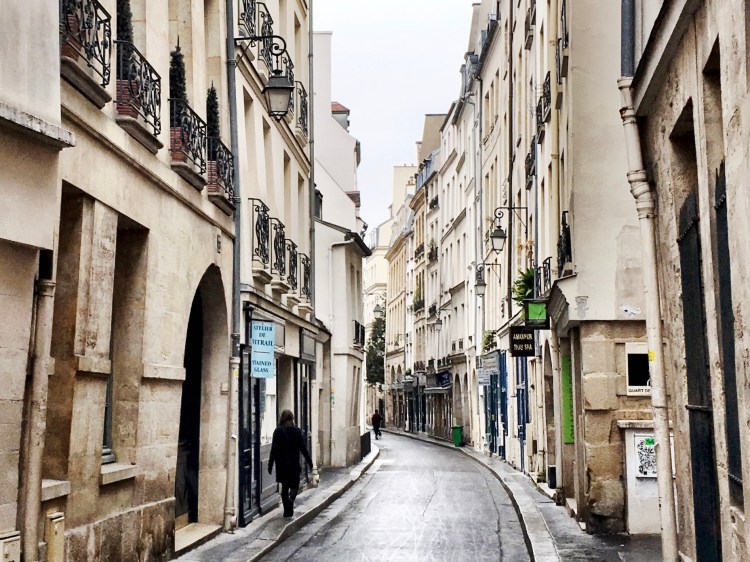
In the heart of the City of Light, Christine Bacoup-Tidas, J.D., stands as a beacon of expertise in the realm of Parisian real estate. As the founder of Tomette Paris and a seasoned independent buyer’s agent, Christine brings a unique blend of legal acumen and an intimate knowledge of the Parisian property landscape to her clients.
Christine has shared her expertise in an exclusive sponsored blog post series about key considerations in the Parisian home-buying journey and personal insights into the city’s arrondissements.
To conclude the blog post series, we delve into the journey that led her to become a trusted independent buyer’s agent in Paris:
What was that journey like when you were first starting to become a buyer’s agent in Paris and why the switch from your former career life to becoming a buyer’s agent?
When I was an undergraduate student living in New York, I worked for a real estate broker that sold properties in Florida. I got my real estate license and did that just for a short while before finishing my undergrad studies and then moving on to law school.
It wasn’t until years later—while my daughter was attending a bilingual school—that I started to really help people find a home in Paris. At the time, I was working as a full-time in-house counsel and then grew my involvement in real estate on the side. I’ve always enjoyed visiting apartments, finding interior design inspiration, and in general, I like to help people and make them happy.
Soon enough, I started to buy property in the fifth arrondissement, the student area. I began by buying a small apartment that I rented to professionals, students, and tourists —and that’s when I realized that I also enjoyed property management.
I became more interested in the real estate market in France, but Paris in particular. It was important to understand the mounting issues about renting out on Airbnb and other regulations in Paris.
Then I decided to just do that full-time.
When did you realize that it was the right time for you to change your career to become an independent buyer’s agent?
Life is not about doing the same thing all of the time. I was a child performer and a ballet dancer in Paris and New York, then I became a lawyer. And I grew up in Paris, then moved to New York, then back in Paris.
So life is about change. Life is about evolution.
At some point in my career as a legal director and compliance officer, I started to get tired of being in the corporate world and working for big companies, so I decided to just do something really different and take what was my hobby and turn it into my own business.
I have no regrets about the change because what I did for many years transposes well to being a buyer’s agent, which involves different elements that I used to use as a lawyer, such as counseling, being of service, negotiating, following compliance, and prioritizing integrity.
I steadily grew my client base mostly through word of mouth—and then COVID hit. While it was pretty quiet during lockdown, I did a lot of writing and started drafting the guide that’s now on my website. It took me a long time to write about the different areas and explain all of the detailed information—it’s almost seventy pages—but I had to do it!
What were the differences between the Paris real estate market before COVID compared to post-COVID and present?
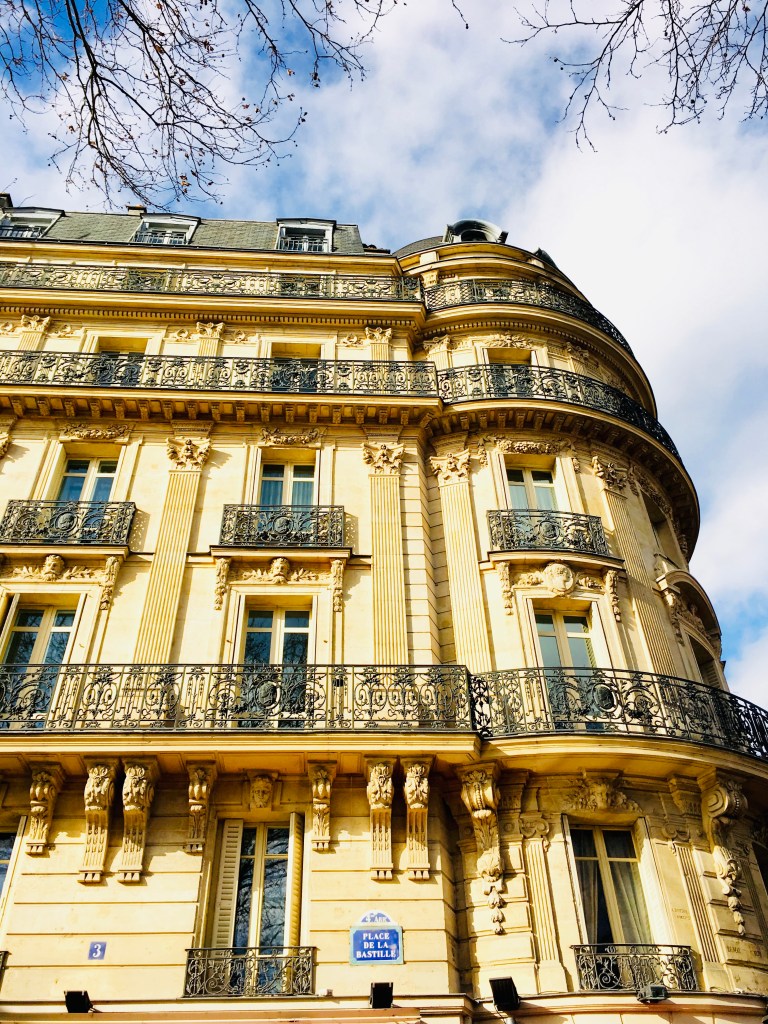
With COVID, more Parisians left Paris to live in the countryside.
During that time, we didn’t know if we would be locked down again and people didn’t want to be confined to a small apartment. As a result, people who had considered leaving Paris before COVID were motivated to move away from the city in a more decisive and quick manner after the lockdown restrictions were lifted.
COVID definitely expedited the fact that more Parisian properties were for sale.
With inflation and increasing interest rates in France, buyers currently have more power to negotiate because most properties are staying on the market longer than during COVID, especially in Île de France, the regional department in France where Paris and its suburbs are located.
“The exceptional rise in property sales during Covid-19 has ended, and the number of sales is beginning to fall. The number of non-new build houses sold between February 2022 and February 2023 was 1,083,000 – a drop of 8.1% compared with the previous 12 months.
[…]
Moreover, while at the end of 2021 the share of Ile-de-France buyers was increasing in the majority of French departments, the situation was different at the end of 2022, when their share had stabilised or shrunk in almost all departments. The largest decreases are mainly observed in the departments bordering or close to Île-de-France, where the share of Île-de-France buyers was the largest and where it had increased most strongly a year ago.
The real estate market, after having reached its peak, is rebalancing, both because of the end of the momentum following the health crisis and because of the continued rise in real estate rates which, due to their extreme weakness, had greatly boosted the market. It should be noted that inflation could continue to alter demand and therefore cause volumes to fall even more sharply, especially as it is likely to weigh on the “disposable income” of potential buyers, especially if the gap between wage increases and price increases is significant.”
French property: analysis of the market jarnuary 2023, notaries de france
When you buy in Paris, the value of the property only goes up over time. Over the past ten years, property value rose over 20%—it is sure to be a safe investment.
Are there any specific arrondissements that are better opportunities or hidden gems that people may not necessarily think of that might be an opportunity?
It really depends on what the client is looking for. Usually, people who want to move to Paris or buy an investment property here are familiar with the city. They typically have an idea of the areas that they like, which helps narrow down the search, and then we can go deeper into that. If they are here in Paris, I can take them to different neighborhoods and explore other areas that they may like.
Let’s start with the ninth arrondissement. There’s a street called Rue des Martyrs, a lovely semi-pedestrian street with lots of flower shops, épiceries, cheese shops, bakeries, restaurants…
Then there’s the tenth arrondissement near Canal Saint-Martin—you can take your bike and just ride, have a picnic by the canal, and shop. There are great restaurants too. It’s very different from the sixteenth arrondissement which is more traditional.
On Rive Gauche, the Left Bank, there’s the sixth arrondissement of Saint-Germain-des-Prés with the Luxembourg Garden, bookstores, and luxury boutiques.

How do you work with your clients who are based in the United States or elsewhere? What does that process look like?
We start with a discovery meeting to introduce ourselves and to identify the client’s criteria for their dream home in Paris. I ask a series of specific questions ranging from ideal location and interior details to lifestyle needs and budget so that I can narrow everything down as much as possible before conducting a search.
In order to anticipate any financial concerns before the formal home-buying process begins, I urge prospective clients to consult with two reputable French mortgage experts so that they know about the various mortgage rates and how much financing they can get. I also advise them to see a French tax lawyer and I can refer them to a contact who is used to working with international clients.
To search for real estate listings, I use a professional tool that has access to listings across all real estate agencies and from individuals, as well as contacts in my network that notify me of off-market opportunities.
As an independent buyer’s agent, I am not tied to a real estate agency. There’s no multiple listing service (MLS) in France, so unless you work with an independent buyer’s agent, you have to go through each individual agency and view their inventory.
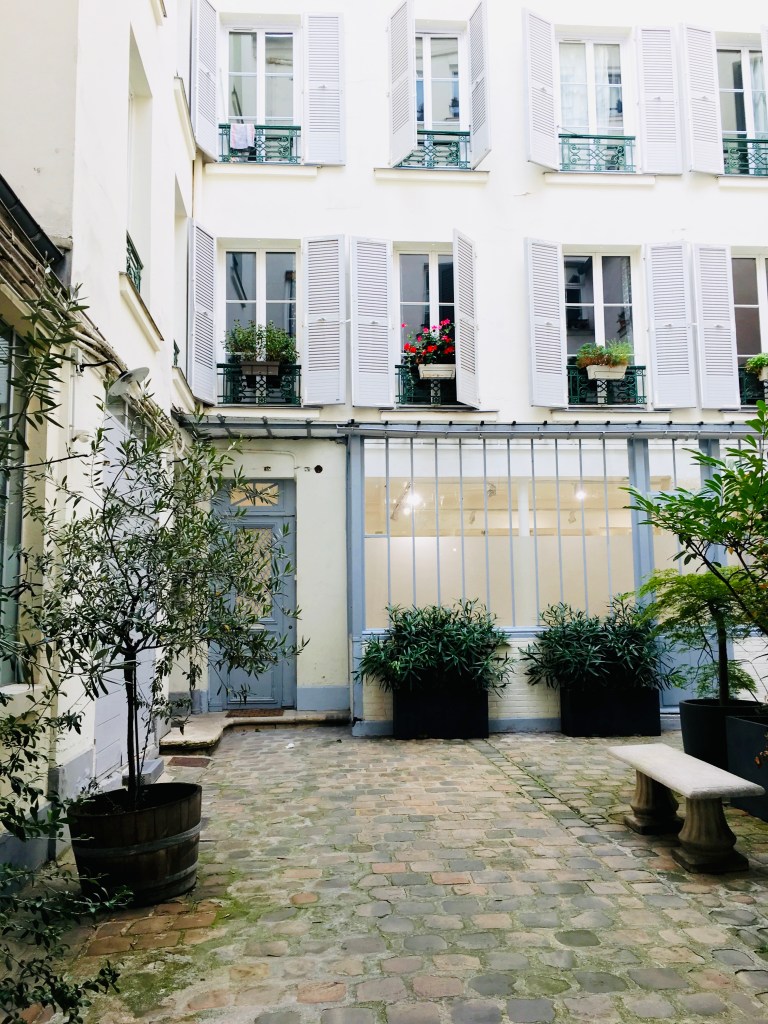
Once I find a selection of listings that I think would match the criteria, I send them to the client for feedback and get a better sense of what they like and what they don’t like. This opens the door to a discussion of the things that they may not have initially thought about, such as the air conditioning, windows, or elevators. For example, a classified historic building cannot have an elevator. A listing may say that there’s an elevator, but it’s actually a service elevator, which is really different from what buyers may be expecting. In the past, service elevators were only used by housekeeping and staff, and not intended for use by the building’s residents and their guests.
If the client decides that they want to learn more about a particular listing, I contact the seller or the agent to confirm that the listing is still available and to get more information about the property.
The listing will always say what there is, but it will usually not say what there isn’t, so you have to read between the lines.
Let’s say that there’s a beautifully renovated apartment with wonderful design—but it’s right on top of a restaurant or a rehab center. Although that’s a significant piece of information to tell potential buyers, the listing will usually not indicate it. This is the kind of information that some real estate agents won’t tell you unless you ask. Otherwise, you may find out when it’s too late to change course.
After I check with the seller and confirm that the property is available and everything is okay, I perform a site visit with my vlog equipment to film the building exterior, the surrounding area, and the interior with my comments.
Depending on what the client prefers, I either have a dedicated private website where I put the video and include links to materials such as legal documents or I send the video and comments via WhatsApp. Once the client receives the materials, we have a discussion to review what they think. If the client is interested, I ask the real estate agent for diagnostics and legal documents that I review to make sure there are no major issues with the building or the apartment or to anticipate any repair or renovation work.
If the client decides to make an offer—and once the offer is accepted—the notary will draft the promesse de vente (preliminary contract). I communicate with the notary throughout the process and make sure that all of the legal documents are secure. After the promesse de vente is signed by both parties, the buyer has 10 days to change his or her mind during the cooling-off period.
The client will typically fly over to see the property before the cooling-off period ends. If a client is interested in meeting with an interior designer or construction company while they are in Paris, I can always help organize any appointments.

Most of your clients are international and are likely to face language and cultural barriers. How do you kind of keep your clients calm and collected throughout the process?
While I do liaise between the seller’s agent, the notary, and partners, I also provide psychological support and counsel to my clients. I build trust by providing as much information as I can so that we can anticipate each part of the process together.
Sometimes it takes 2 months to find the right property. Usually, I find it very quickly in a matter of weeks or days. But I always reassure my clients that I am there for them every step of the way.
What do you love the most about living in Paris and France?
I love the French art de vivre and the way that it’s embedded in the culture.
In France, there’s always been that notion that life is not all about work. There’s something else besides work, like eating good food and taking the time to enjoy life.
In the US, things have a tendency to go really, really, quickly like in New York City. Meanwhile, in France, it’s a slower pace, so you learn to be patient.
Over the past twenty years, I’ve learned to be patient. There are some moments that may feel too slow for me, but at the same time, it’s good—and I enjoy that very much.
Meet Christine
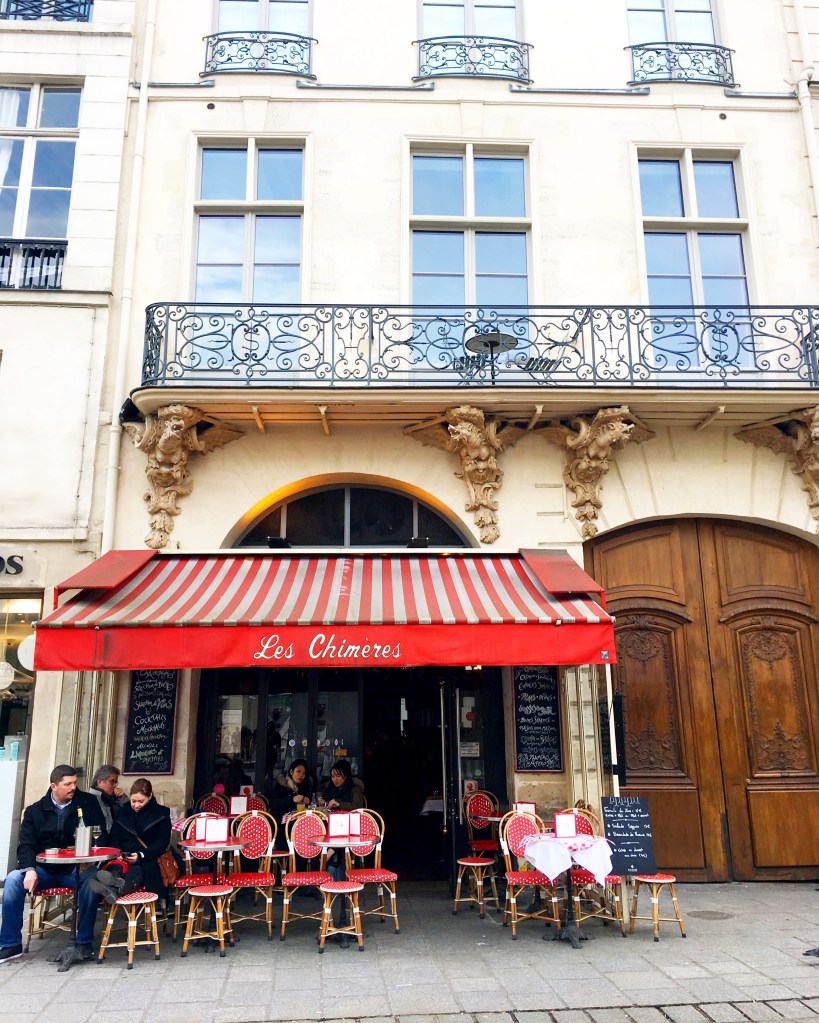
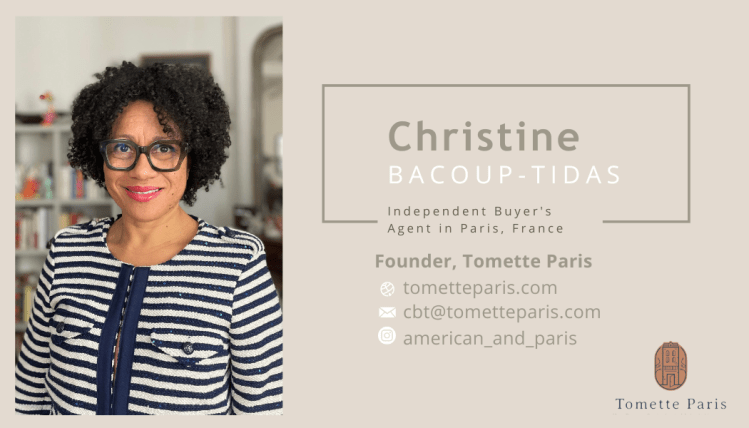
Christine Bacoup-Tidas, J.D. is the founder and owner of Tomette Paris.
She is French-American and provides independent buyer’s agent services in Paris, France.
Christine lived and worked in New York City for 16 years as a lawyer before returning to France in 2002.
Since relocating to Paris, she has made it her mission to share her love of Paris and help others achieve their property goals seamlessly, especially those who, like herself, were navigating the Parisian real estate market from a distance.
Christine earned her B.A. in Political Science and International Relations at Hunter College and subsequently obtained her J.D. from the Jacob D. Fuchsberg Touro Law Center. Christine is also a member of the Association of American Women in Europe (AAWE) and the Professional Women’s Network in Paris (PWN).
Christine lives in the Latin Quarter with her husband and daughter.
Connect with Christine on Instagram, Facebook, YouTube, and LinkedIn.
This blog post has been edited for clarity and improved readability. While every effort has been made to maintain the accuracy and integrity of the content, some revisions have been made to enhance its overall quality and coherence.
 New England Parisienne