

Why Host a Wine Tasting at Home?
Wine tasting is a highly underrated activity.
It’s like hosting a cocktail party, but it’s a low-pressure social setting to have people of various degrees of separation interact with one another.
The best part of wine tasting in a group? When you run out of things to talk about, bring the conversation back to the wine.
Want to dodge a question about what you do for work? Talk about the wine.
Don’t feel like answering a question about whether or not you want to have kids in the next five years? Talk about the wine.
Speechless over an unnecessary comment about current events? Take a big sip before switching gears to talk about the wine.
Would you rather avoid answering a question about what happened with your last relationship and the real reason why it ended (UGH)? Finish your glass with a swift sip, pour yourself another glass, and talk about the damn wine.

While some people may say otherwise, there’s no reason to be intimidated when it comes to the world of wine—having good humor and agreeable enthusiasm goes a long way to understanding the various characteristics of different wines.
What makes wine interesting is that everyone has different tastes and opinions. One of the things that may make learning about wine seem intimidating is that there’s so much to talk about—where the wine comes from, who makes the wine, how has the wine changed over time, the taste profile, and how it’s changed across different vintages, etc. Some wines are simple and straightforward. Other wines are more complex and require more thought.
Red, white—or whatever it is—enjoy the journey.
And there’s really no wrong answer when it comes to figuring out what you like. The formula is simple—taste, decide if you like it, and—if you feel like it—figure out what you liked (or what you didn’t like). That’s it. Unless you’re training to be a Master Sommelier or Master of Wine—and most people aren’t—there’s no reason to take wine so seriously.
Breaking bread and drinking wine go hand-in-hand, so your wine tasting can easily be either casual or chic, depending on your mood and your guest list.
Here are some tips and tricks on how to host a successful wine tasting:
- Why Host a Wine Tasting at Home?
- How to Select Wines for an At-Home Wine Tasting
- Suggested Food and Snack Pairings with Wines
- What You’ll Need for a Successful Wine Tasting Party
- Learn the basics of wine-tasting

How to Select Wines for an At-Home Wine Tasting
Brainstorm what types of wines that you and your guests may be interested in exploring and categorize them into themes. Be sure to also consider the price and availability of the wines. To ample variety, yet avoid palette fatigue, 6-8 wines are recommended for an interesting wine tasting.
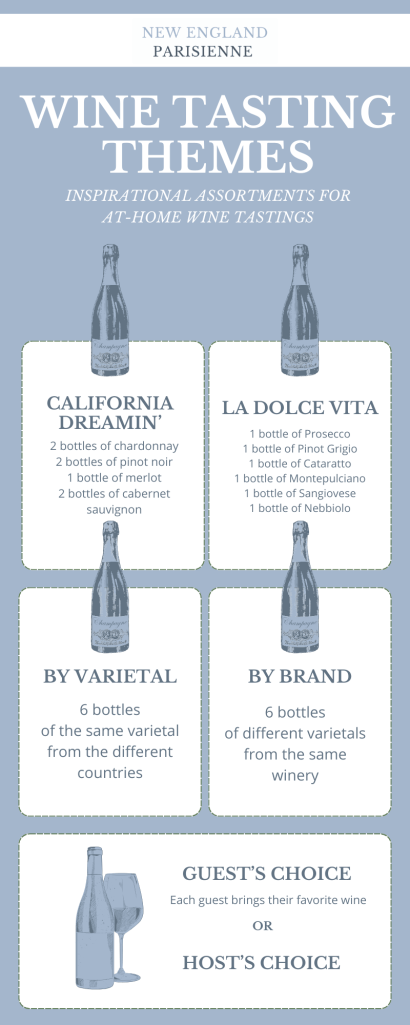
Here are some examples of potential themes for a wine tasting—this is not meant to be exhaustive or taken literally, so adjust to your party’s preferences, experience level, and budget!
Wine Tasting By Country/Region
California Dreamin’, Napa Edition
- 2 bottles of Chardonnay
- 2 bottles of Pinot Noir
- 1 bottle of Merlot
- 2 bottles of Cabernet Sauvignon
Bienvenue à Bourgogne (Welcome to Burgundy, France)
- 3 bottles of Chardonnay from Burgundy
- 3 bottles of Pinot Noir from Burgundy
La Dolce Vita (Italian wines)
- 1 bottle of prosecco (Veneto)
- 1 bottle of Pinot Grigio (Alto Adige)
- 1 bottle of Catarratto (Sicily)
- 1 bottle of Montepulciano (Abruzzo)
- 1 bottle of Sangiovese (Tuscany)
- 1 bottle of Nebbiolo (Piedmont)
Wine Tasting By Varietal
Around the World, Pinot Noir
- 1-2 bottle(s) from Burgundy, FR
- 1-2 bottle(s) from California, US
- 1 bottle from Oregon, US
- 1 bottle from Marlborough, NZ
- 1 bottle from Baden, GER
Around the World, Sauvignon Blanc
- 1 bottle from the Loire Valley, FR
- 1 bottle from Bordeaux, FR
- 1 bottle from Marlborough, NZ
- 1 bottle from California, US
- 1 bottle from Chile
- 1 bottle from South Africa
One Brand, Multiple Varietals
- 1 bottle of Sauvignon blanc (ex: Josh Sauvignon Blanc)
- 1 bottle of Chardonnay (Josh Chardonnay)
- 1 bottle of Pinot Noir (Josh Pinot Noir)
- 1-2 bottle(s) of Cabernet Sauvignon (Josh Bourbon Barrel Cabernet Sauvignon, Josh Cabernet Sauvignon)
One Brand, Same Varietal, Different Vintages or Cuvées
- 6 bottles from different years and different price points (ex: 2020 Volpaia Chianti Classico vs. 2017 Volpaia Chianti Classic Riserva)
Celebrity Wine Brands
- 1 bottle of Miraval rosé (Angelina Jolie and Brad Pitt—or at least formerly)
- 1 bottle of Hampton Water (Jon Bon Jovi)
- 1 bottle of Maison No. 9 (Post Malone)
- 1 bottle of Invivo x SJP sauvignon blanc (Sarah Jessica Parker)
- 1 bottle of Avaline red blend (Cameron Diaz and Katherine Power)
- 1 bottle of Francis Ford Coppola claret wine (eponymous)
Guest’s Choice
- Each guest brings a bottle of their favorite wine
Blind Tasting
- This is a great way for guests to focus on the differences and have fun guessing! It works for any of the suggested wine selection themes
Host’s Choice
Whatever you want!
Once you decide on potential themes, share the list with your invited guests so that each person may vote to finalize the theme.
To avoid chaos and confusion among your guests, it may be best for you to select the wines yourself—and with a little extra help from your local wine shop.
For a more budget-friendly approach, you may ask guests to either bring one bottle of wine or evenly split the cost of the wines via Venmo. While it may seem off-base to ask your guests to contribute, it’s entirely reasonable to do so when the cost per bottle is higher than $30 (i.e. champagne).
Suggested Food and Snack Pairings with Wines
The food pairings will entirely depend on the chosen theme of your assortment—if you decide for your guests to bring their own wines, this enforces the importance of being specific on what they bring (or, at the very least, ask that you are given sufficient notice in advance of their choice so that you can plan accordingly).
A wine tasting should offer a few small plates and snacks to be lightly enjoyed alongside the wines or afterward.
For a more casual vibe, feel free to ask guests to bring a small appetizer or snack for the number of people in attendance.
Some examples of snacks and small plates that are appropriate for wine tastings include:
- Selections of cheese and charcuterie, ideally to complement the selected countries/regions/varietals
- Bread, crackers
- Popcorn
- Italian meatballs
- Cheese tortellini or ravioli
- Arancini or risotto bites
- Quesadilla
- Hummus and pita
- Pâté
- Oysters
- Caviar
This Food & Wine article goes into more depth about suggested food pairings.

What You’ll Need for a Successful Wine Tasting Party
Aside from the wines themselves, make sure you have everything you need to entertain your guests and properly prepare the wines—
- wine glasses
- corkscrew
- white paper (or white neutral background)
- wine chiller/ice bucket for white wines
- coasters
- napkins/paper towels
- wine bottle stoppers (for remaining wines, if necessary)
- small wine bucket or paper cups (for spitting, if necessary)
- decorations (optional)

- Marble Honeycomb Coasters, Set of 4
- Laguiole Jean Dubost Waiters Corkscrew
- Zwiesel Glas Vervino Glassware Collection
- Marble & Brass Wine Chiller
- Williams Sonoma Heritage Champagne Stopper
Learn the basics of wine-tasting
Review the five steps of wine tasting, better known as “the five S’s“
See the wine
Observe the color, opacity, and depth against a sheet of white paper or a light, neutral background
Swirl the wine
Gently swirl the wine in the glass to release the aromatics
Smell the wine
Bring the wine glass to your nose, inhale, and focus on finding the primary, secondary, and tertiary fragrance notes (Vinepair explains why smelling the wine is important)
Sip the wine (and swish)
Savor the wine
Pay attention to the aftertaste (finish) of the wine
Working through each step together and having conversations over each ‘S’ will encourage guests to be more thoughtful about their observations than usual. Each person will pick up on different characteristics, so have fun exchanging notes and exploring the wines!
Cheers!


 New England Parisienne
One thought on “Step-by-Step Tips for Hosting a Wine Tasting at Home”